Steven L. Parente PE
Electric Power, Caterpillar Inc.
This paper is intended to be shared with individuals involved in on-site electric power generation to provide an overview of Caterpillar experience with using hydrogen in reciprocating (recip) engine-powered generator sets.
This paper addresses the following:
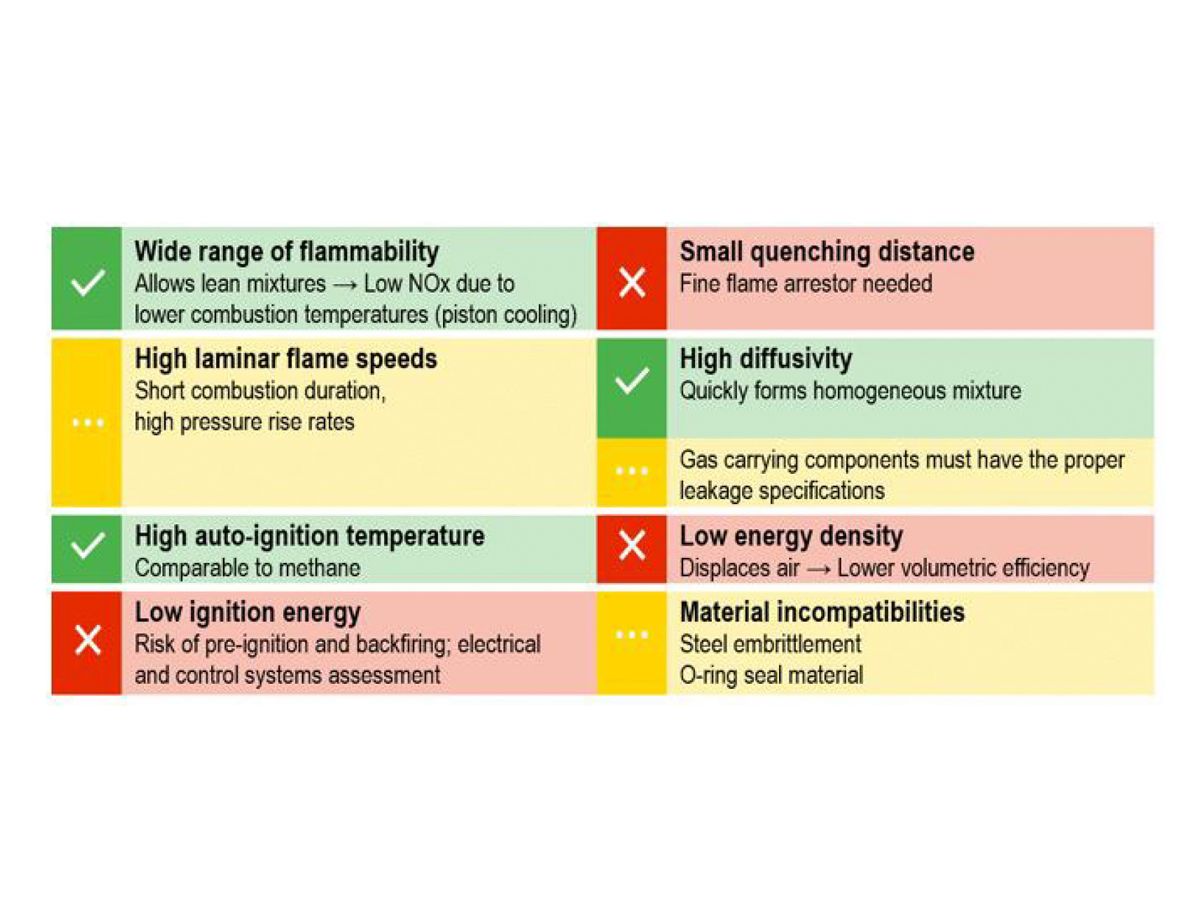
While the design of a hydrogen-enabled reciprocating engine is similar to a standard natural gas engine, there are several factors to consider when accounting for the distinct properties of hydrogen. Figure 1 below presents a way to distinguishes these factors:
The first of the positive (green) considerations for hydrogen is its wide range of flammability. This allows very lean fuel mixtures that promote low combustion temperatures resulting in lower NOx values.
The high diffusivity from hydrogen helps to form homogeneous mixtures and to create a well-mixed charge in-cylinder when utilizing port injection or direct injection fuel systems.
In considering manageable (yellow) factors, high laminar flame speed is positive because there is better efficiency out of the short combustion duration, but high pressure rise rates add mechanical stress to the engine. This increased mechanical stress can be managed through a combination of engine design and power derate. High auto ignition temperatures comparable to methane require no related changes.
Consideration must be given to the specifications for gas-carrying components to minimize the incidence of hydrogen leakage. To that end, one should adhere to suppliers’ application and installation instructions for items like proper engine room ventilation and proper hydrogen gas train installation.
Also, consideration must be given to material incompatibilities, specifically the steel embrittlement and O-ring deterioration caused by hydrogen. This requires careful analysis to ensure the correct materials are used in the engine.
Regarding the factors requiring significant modifications (red), the low ignition energy of hydrogen increases the risk of knocking, pre-ignition, and backfiring, which drives the need for good engine control systems and management of the electrical systems per regulation requirements.
Small quenching distances drive the need for flame arrestors for fumigated fuel systems operating with hydrogen blends with natural gas or 100% hydrogen in order to prevent combustion in the intake manifold. Inclusion of these arrestors may require higher air intake pressure, depending on their sizing. We note that port or direct injection hydrogen systems would not normally require flame arrestors.
Although hydrogen has the highest energy content on a mass basis, the very low density of hydrogen means that on a volume basis, hydrogen has less energy than natural gas at the same temperature and pressure. For fumigated and port injected hydrogen engines, a turbocharging system with higher pressure ratios could be required to compensate and minimize the volumetric efficiency impact.
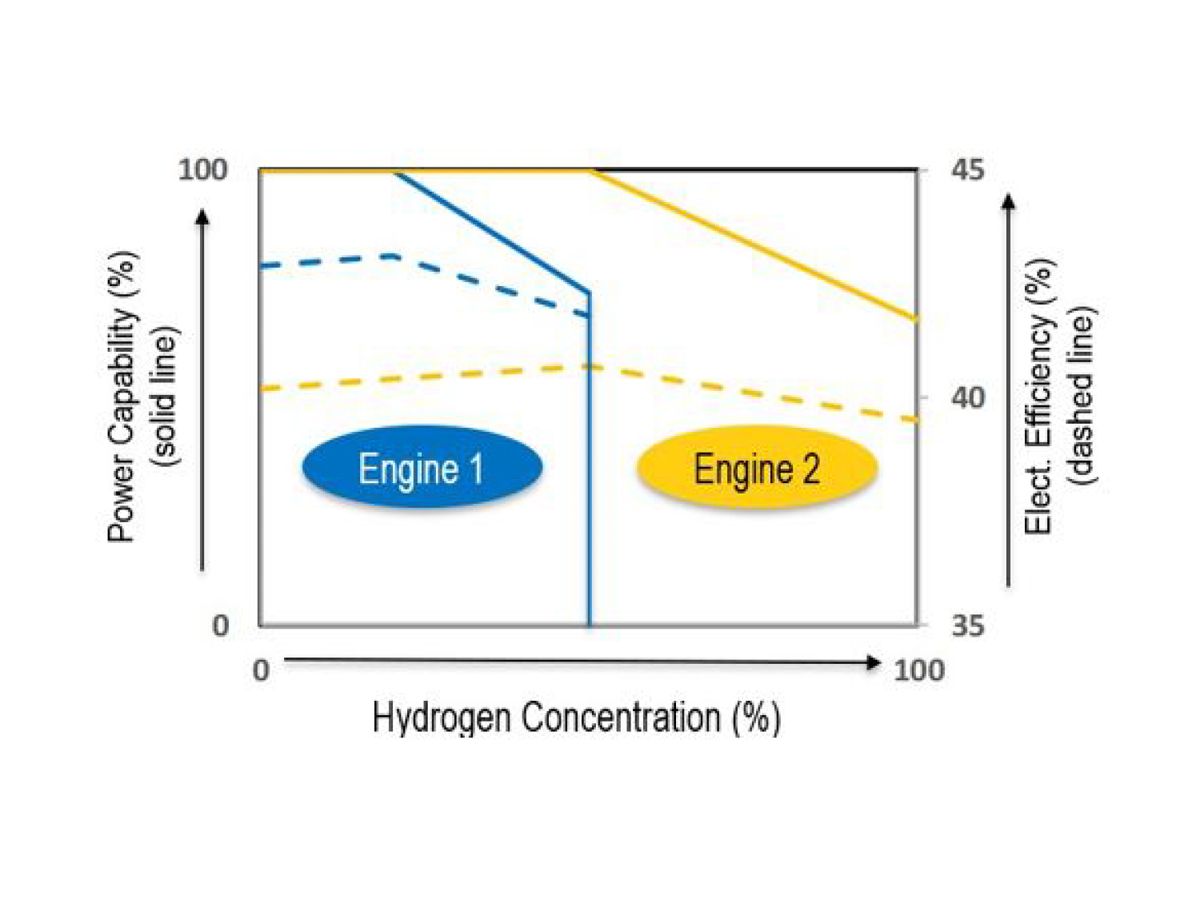
Hydrogen reciprocating engine customers prioritize several factors such as fuel source, power output, efficiency, emissions, capital costs, and operating costs. Hydrogen reciprocating engines can be optimized for these factors but experience trade-offs such as the hydrogen blending capability vs. efficiency trade-off shown in Figure 2.
The blue oval represents a typical natural gas engine. This engine is able to operate with a hydrogen blend of up to approximately 25% without an impact to electrical efficiency; in fact, efficiency slightly increases as hydrogen concentration increases. As hydrogen blend percentage increases beyond 25%, the engine derates until it no longer run due to detonation (i.e. the spontaneous combustion of end-gases), at which point the engine cannot accept additional load.
The yellow oval represents an engine similar to those available today but with a decreased compression ratio, as well as minor changes to the software and the turbocharging system. This engine is able to operate with a hydrogen blend of up to 60% without any significant derate, and thereafter with a derate up to 100% hydrogen, where it is rated at approximately 60% of the natural gas rating. The lower compression ratio results in marginally reduced electrical efficiency of just below 40%.
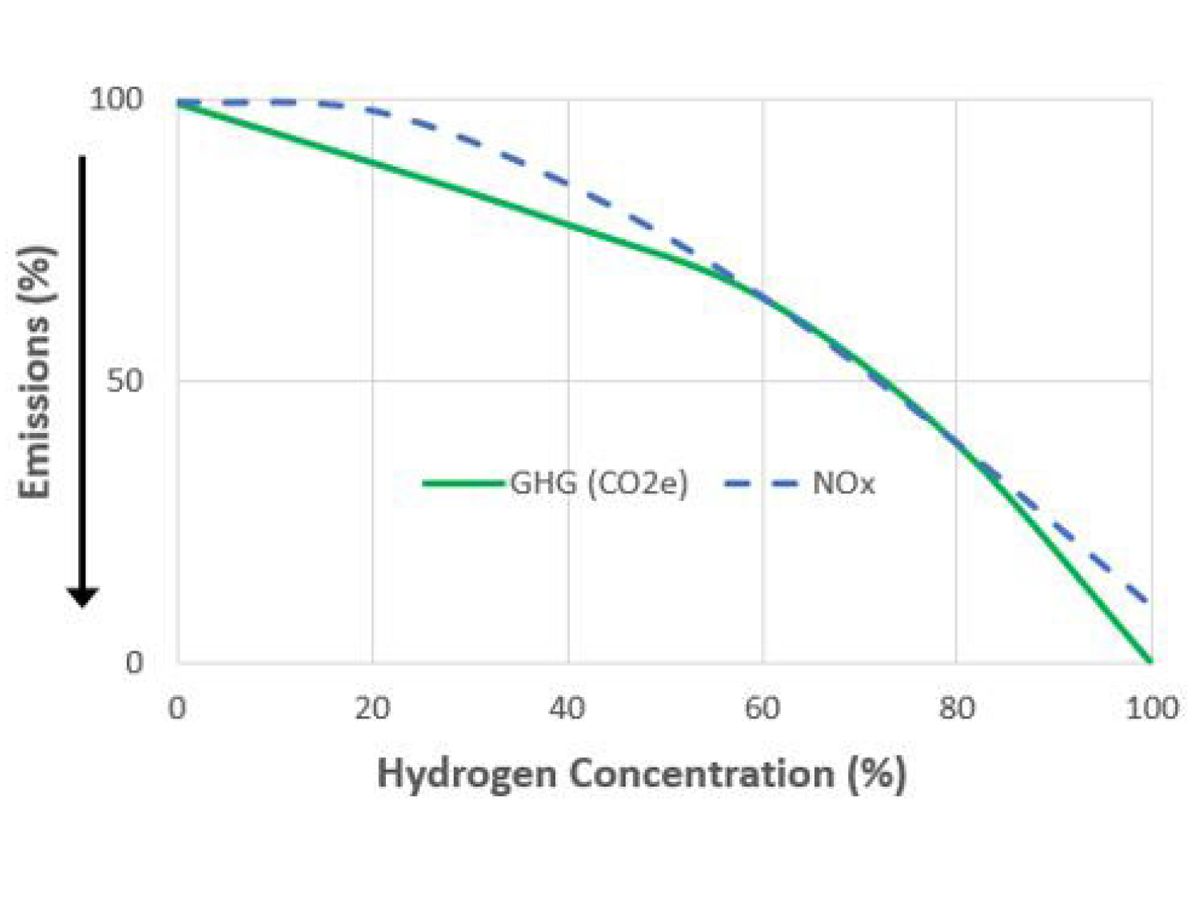
Figure 3 shows how increasing hydrogen concentration reduces GHG emissions because a carbon-based fuel (natural gas) is being replaced by a carbonfree fuel (hydrogen). GHG emissions with 100% hydrogen are virtually zero with only minimal CO2 emissions from the small amount of oil combusted in reciprocating engines. NOx emissions are reduced based on the control system and combustion of leaner air-to-fuel ratios with higher hydrogen blends. From 0 to 20% hydrogen, the control system uses the NOx sensor input to maintain the NOx setting.
Additionally, with 100% hydrogen combustion, there are no unburned hydrocarbon emissions which means an oxidation catalyst is not needed. This presents a win-win situation by eliminating the need for oxidation catalysts, thereby reducing initial cost, and significantly reducing GHG and NOx emissions with 100% hydrogen.
The initial costs of diesel engines are relatively small, and they increase when looking at natural gas engines because of the additional hydrogen specific components covered in the design considerations discussed above. In all cases, the cost of a generator set is still not high when compared with current fuel cells and batteries. Though the costs for fuel cells and/or batteries may fall in the future.
Battery energy storage can be utilized in conjunction with reciprocating engines, turbines, and fuel cells to achieve transient performance requirements, but it does add costs.
A different picture emerges when considering relative fuel costs. Figure 4 shows the relative fuel costs for a set of fuels on a diesel gallon equivalent (DGE) basis. Natural gas proves to be the lowest cost option. The cost to produce hydrogen from natural gas can be quite low, however, the price of delivered hydrogen shown here includes the cost to liquify or compress the hydrogen and then transport it.
Note that the cost shown in Figure 4 is based on hydrogen derived from fossil fuels. When considering hydrogen produced from renewables (green hydrogen), the additional costs for infrastructure are the same, but the production costs are expected to remain higher than those for grey hydrogen for at least the near future.
The production costs of renewable hydrogen are eventually expected to be reduced and could match natural gas or diesel.
The starting point of any risk analysis is to identify and understand the hazards that are present. The risks of hydrogen are similar to other flammable gases, such as natural gas, which is commonly used in power solutions.
However, there are differences between hydrogen and natural gas. For example, hydrogen has a wider flammability range and requires less energy to ignite.
Additionally, hydrogen is odorless, tasteless, and colorless. There are no commercially available odorants for hydrogen as there are for natural gas today. As a result, gas sensors are relied on to aid in the detection of leaks.
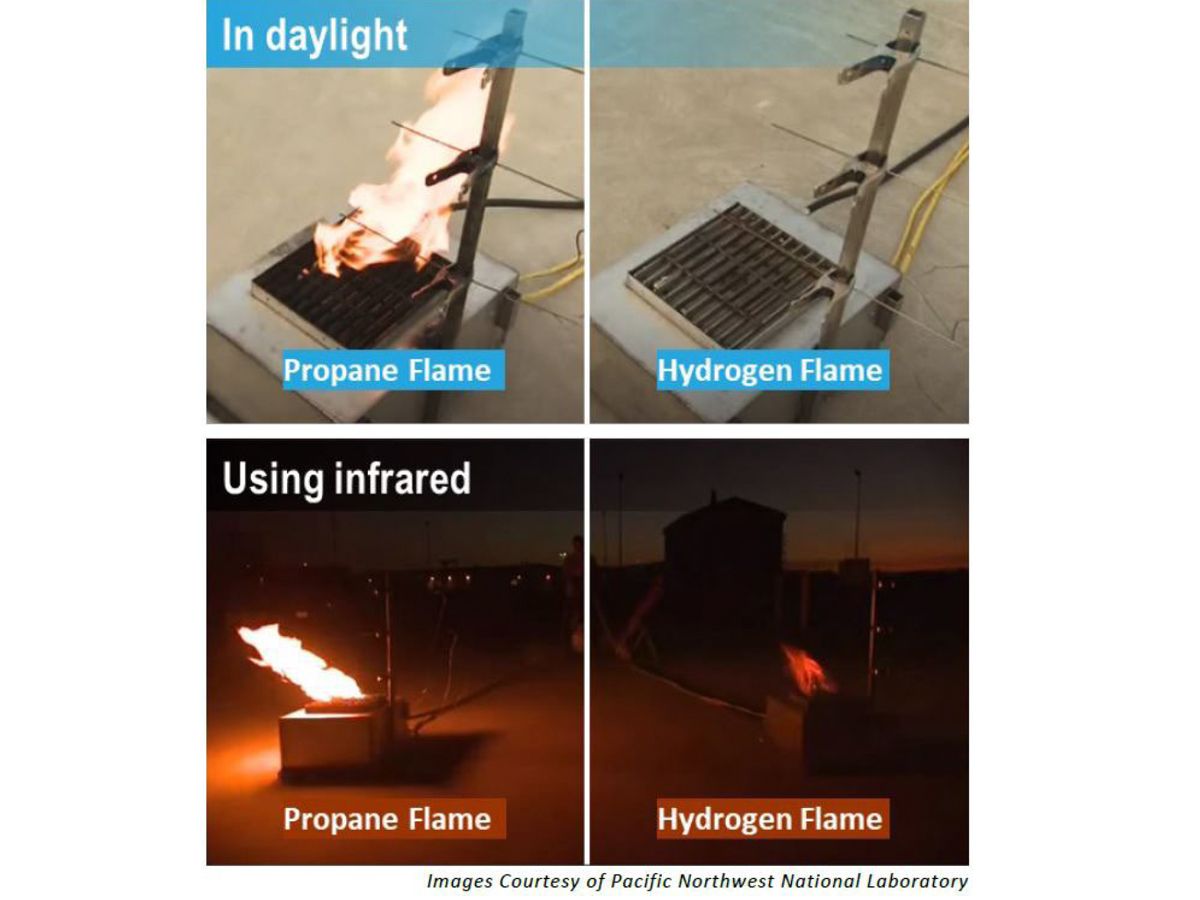
Hydrogen flames generate relatively low radiant heat and can be difficult to see in daylight. As an example, Figure 5 shows photos of propane flames next to hydrogen flames and prove the difficulty in visually detecting hydrogen flames. The propane flame is highly visible in daylight, while the hydrogen flame is nearly invisible. Using an infrared filter, the propane flame is highly visible, while the hydrogen flame is barely visible.
Despite these risks, hydrogen is commonly used in other industrial processes, and there are proven methods for mitigating these known hazards. These include regular inspections and leak testing, the implementation of fault-tolerant controls, and the use of fire and gas detection systems, to name a few.
Caterpillar has experience using a wide range of alternative fuels in its gas generator sets. This experience includes operating on hydrogen blends of up to 60% (like coke gas) for nearly 40 years. Globally, Caterpillar has applications that actively blend varying amounts of hydrogen into the natural gas fuel supply to consume it in a generator or combined heat and power (CHP) systems. Solar Turbines, a Caterpillar company, has been operating gas turbines on hydrogen enriched fuels since the 1980s with more than 2 million accumulated operating hours.
Caterpillar views hydrogen as one of the fuel sources that can contribute to a reduced GHG emissions future. Caterpillar continues investment and research into power generation from hydrogen blends and pure hydrogen at Caterpillar facilities and customer sites. Caterpillar recently concluded a demonstration of a 1.5MW hydrogen fuel cell backup power solution together at an operating datacenter. In addition, a 2 MW combined heat and power (CHP) flex fuel genset has been demonstrated to provide both power and heat consuming either natural gas or 100% hydrogen with the same packaged genset.
Since 2022, Caterpillar has offered demonstrator Cat® G3516 gas generator sets capable of operating on 100% hydrogen. This work leverages Caterpillar’s deep performance simulation experience, especially on combustion and flame propagation. Additionally, Caterpillar offers gas generator sets from 400 kW to 4.5 MW that are approved to operate on gas containing up to 25% hydrogen by volume. These capabilities are available through factory-installed hardware and retrofit kits for generator sets already in the field.
Hydrogen can be used as a fuel to provide power with near zero tailpipe GHG emissions. Additionally, hydrogen can act as energy storage by using excess electricity to produce hydrogen, storing the hydrogen, and using the hydrogen to produce power when generation is needed.
As with many new technologies, there is a cost barrier for early adopters of hydrogen fuel but there are indications that costs could decrease in the future to make hydrogen more competitive with traditional fuels like diesel and natural gas. Caterpillar is already offering reciprocating engines (and turbines) capable of operating on hydrogen and hydrogen blends. We continue to improve the capability of hydrogen-powered reciprocating engines with minimal impact on maintenance costs and schedules, availability, and operations. We are continuing to invest in hydrogen technology and are well positioned to serve the needs of power generation customers and the marketplace with hydrogen-fueled power generation solutions.