
Fueling What's Next
A Practical Look at Alternative Fuels for Today’s Operations

Electrification is a big focus in the changing energy landscape and for good reason. Battery-powered equipment can play a significant role in reducing emissions. With all the attention paid to electric solutions, it’s easy to overlook this truth: electrification isn’t the only path forward. And it may not be practical for every customer’s application.
Alternative fuels can offer another route to lower emissions and support sustainability goals. In some cases, they can complement or serve as a bridge to electrification — particularly when electric equipment isn’t yet available or feasible for the job.
At Caterpillar, we’ve been building engines that run on different fuels for more than 90 years. (Fun fact: We converted our dozers to run on propane and butane back in the 1930s.) Today, we’re expanding that legacy with investments in products that can run on a range of alternative fuels, so our customers have the flexibility to choose what works best for their applications.
Thinking about making the switch? Here are a few things to keep in mind as you evaluate your options.
Five Fuels to Know
Google “alternative fuels” and you’ll get millions of results — from vegetable oils to synthetic molecules and everything in between. It can be overwhelming. To help simplify the conversation, here are five of the most relevant options for those who operate Cat® equipment today:
- Biodiesel is a renewable fuel made from animal or plant-based materials, typically blended with diesel (like B20) or used on its own (B100). It’s widely available, but may degrade over time, high blend ratios are not compatible with low emissions engines, and it usually presents challenges in cold weather.
- Renewable diesel (RD, R100) is another fuel made from animal or plant-based materials. It’s a drop-in replacement for diesel with a long shelf life, but it can be harder to find and more expensive due to demand.
- Methanol is an alcohol-based fuel primarily used in marine applications today. Conventional methanol is fossil-fuel based, but bio and e-methanol versions can offer more than a 90% reduction in lifecycle greenhouse gas emissions*. Accessibility can be limited inland.
- Ethanol is another alcohol-based fuel widely used in parts of the Americas and often blended into gasoline. It’s also being explored as a renewable energy carrier for power generation.
- Hydrogen is a gaseous fuel that can be used in internal combustion engines or fuel cells. When produced using renewable sources, hydrogen offers the potential for low or near-zero CO₂ emissions, but infrastructure, storage and cost remain key challenges.
Also, don’t overlook e-fuels — like e-diesel and e-methanol — which are produced using renewable electricity and captured carbon. While still in the early stages of development, they represent a promising long-term option with some of the lowest lifecycle carbon intensities.
*Source: 2021 IRENA & Methanol Institute Report
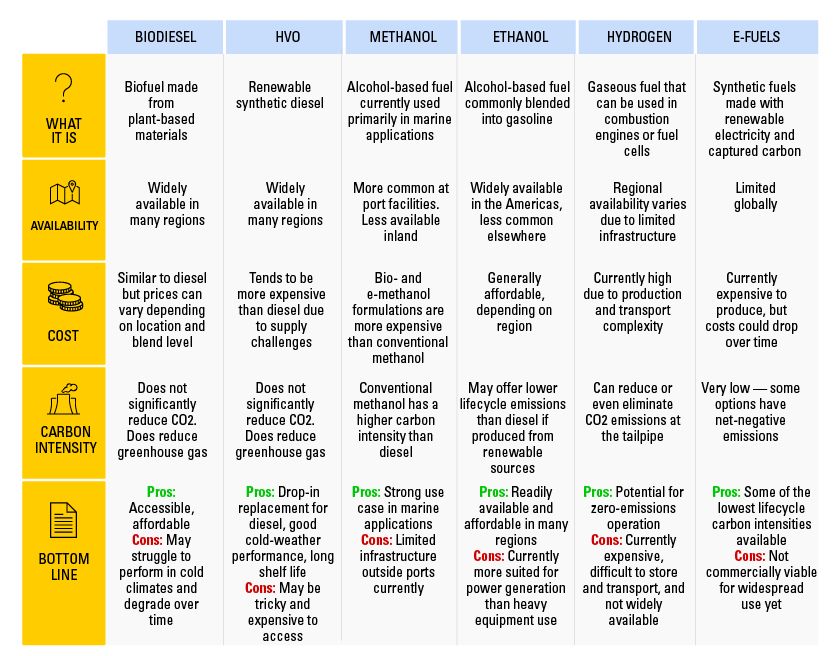
Weighing the Tradeoffs
No single fuel checks every box. The best choice depends on your region, your application and your sustainability goals. As you explore the options, consider how each fuel stacks up in three key areas:
- Availability: Fuel access can vary significantly by location and industry. Ethanol and biodiesel are widely distributed in many areas. Others like HVO, methanol and hydrogen may be more localized or emerging. Logistics matter, too. Consider how easily a fuel can be stored, transported and dispensed at your site, particularly if it’s temperature-sensitive or requires special handling.
- Cost: Upfront price is only part of the picture. Think about your total ownership costs, which might include fuel transport, storage infrastructure, handling protocols and even operational efficiency. Some fuels command a premium today, especially those in early development or high demand. Others may offer cost parity with diesel, especially in regions with incentives or mandates.
- Carbon intensity: Are you aiming to reduce emissions at the tailpipe or across the full lifecycle of the fuel? Biodiesel and HVO, for example, may lower lifecycle emissions even if tailpipe output remains similar to diesel. Options like hydrogen and e-fuels can offer significantly lower lifecycle carbon intensity when produced from renewable sources, but those benefits depend on how the fuel is generated.
Where Caterpillar Comes In
You might be searching for a quick drop-in replacement for your current fleet. Or you might be looking for a lower-emissions solution to support electric charging or site power where grid access is limited. Either way, you’ve got options — and they’re already in use today.
At Caterpillar, we’re actively supporting operations across the globe as they evaluate and apply alternative fuels including biodiesel, HVO, hydrogen, methanol and ethanol in Cat equipment, engines and gensets. We’re also collaborating with customers and industry groups to define fuel specifications, adapt engines for fuel compatibility and validate performance in real-world environments.
For us, flexibility isn’t just about fuel type. It’s about giving you more options to keep working, support your sustainability goals, and prepare for what’s next.
Want To Explore Your Alternative Fuel Options?
Whether you’re ready to act now or just starting to explore, our team can help you assess what’s available in your region, understand compatibility with your current equipment and determine which solutions align with your goals. Reach out anytime to start the conversation.
David Kleiner
Business Development, Caterpillar Electrification + Energy Solutions
David Kleiner joined Caterpillar in April 2025 as Business Development for Alternative Fuels. Before joining Caterpillar, David led the deployment of Toyota’s hydrogen ecosystem at Long Beach, CA, where he oversaw the implementation of a tri-gen fuel cell system supplying port operations with electricity, water, and hydrogen, enabling fueling for both electric and fuel cell vehicles and trucks.
Throughout his career, David has positioned himself at the intersection of technology and business, leveraging innovative solutions to address complex challenges. His professional journey has been dynamic and non-linear: beginning as a Naval Flight Officer, transitioning to Aerospace Engineering, moving into Cybersecurity and Enterprise IT, and eventually leading an Innovation Lab focused on logistics, manufacturing, marketing, and environmental issues.
David is driven by two core passions: environmental sustainability and immersive technology. He is a recipient of numerous marketing awards, holds four patents, and has been featured in the press and as a conference speaker.
Outside of work, David enjoys the great outdoors; hiking and snowshoeing in the San Juan Mountains or kayaking the serene waters of the Straits of Juan de Fuca.
Related Blogs
-
Kicking Off Our Next Century of Innovation with the 972 Technical Demonstrator
2025 marks Caterpillar’s centennial year, and I can’t think of a better place to launch the celebration than CES 2025. Why’s that? Because innovation has driven our success — and more importantly, our customers’ success — for a century now. After all, Caterpillar was built on a breakthrough: Our founders revolutionized the work for farmers in the early 1900s by replacing the wheels on a tractor with tracks. The rest, as they say, is history.
Learn More -
Innovations for Advancing Jobsite Energy Solutions
Read about two real-world examples of how a holistic approach helped construction companies navigate an evolving energy landscape.
Learn More -
Holistic Solutions for Jobsites of the Future
See where electrification is headed and how you can have the most success in your energy transition journey.
Learn More -
Going Electric? Go Digital, Too.
Think about what’s required to keep your diesel-powered machine running. For the most part, if you conduct regular preventive maintenance and keep it fueled up, you’re good to go. Things aren’t so simple with electric equipment.
Learn More -
Charging Ahead: 4 Questions to Ask Now
If you operate heavy equipment today — one machine or a fleet of hundreds — then you have some sort of refueling strategy in place. Maybe diesel gets trucked to your sites once or twice a day, so machines can fuel up and keep working with little interruption.
Learn More -
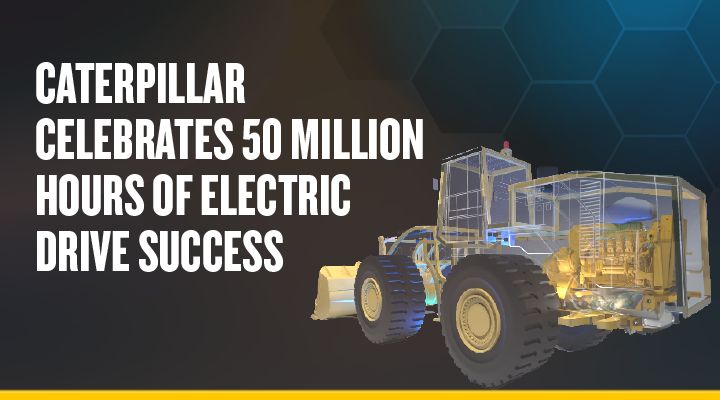
50 Million Hours of Electric Drive Success
Many of us think of electrification as a relatively recent trend. After all, it’s been less than 30 years since the launch of the first mass-produced hybrid vehicle (Toyota Prius) and just 15 since the debut of the first mass-market EV (Nissan Leaf).The fact is, from the mid-1990s through today, nearly 9,000 Cat® products with electric drivetrains have been working on customer sites. In 2024, that equipment topped 50 million hours of operation, which is equivalent to 5,704 years.
Learn More

Your Business
 North America – English
Caterpillar Brands
- Caterpillar.com
- My Marketing Preferences
- Site Map
- Cookie Settings
- Legal
- Privacy
- Do Not Sell or Share My Personal Information
- Accessibility Statement
- US-English
- © 2026 Caterpillar. All Rights Reserved.